We can know all about someone.
We can study their life. Know where they live, their favorite color, where they went to school, what they believe, even the things they share online.
We can follow them for years. Listen to them speak. Read what they write. Know their story.
But that doesn’t mean we actually KNOW them.
It doesn’t mean we call them when life falls apart. It doesn’t mean we trust them with the parts of our lives we keep private. It doesn’t mean we ask for their advice or allow their words to influence how we live.
There is a difference between knowing ABOUT someone and truly KNOWING them.
Oftentimes, we get the two confused.
Truly knowing someone holds weight.
It’s relational.
It’s reciprocal.
It requires vulnerability.
It requires honesty.
It requires trust.
And I think sometimes we do the same thing with Jesus.
Even the Demons “Knew” Jesus
We can know the stories.
We can know the verses.
We can study the historical context, learn the theology, memorize Scripture, and know what Jesus taught.
We can go to church every week.
We can serve in the church.
We can volunteer, lead, teach, give, show up, and stay busy doing things “for God.”
We can learn the language. Know when to raise our hands. Know when to say amen. Know the right answers to the questions.
We can do all the things that look like following Jesus from the outside.
And still never actually KNOW Him.
Because proximity to the things of God is not necessarily intimacy with God.
Even the demons “knew” Jesus.
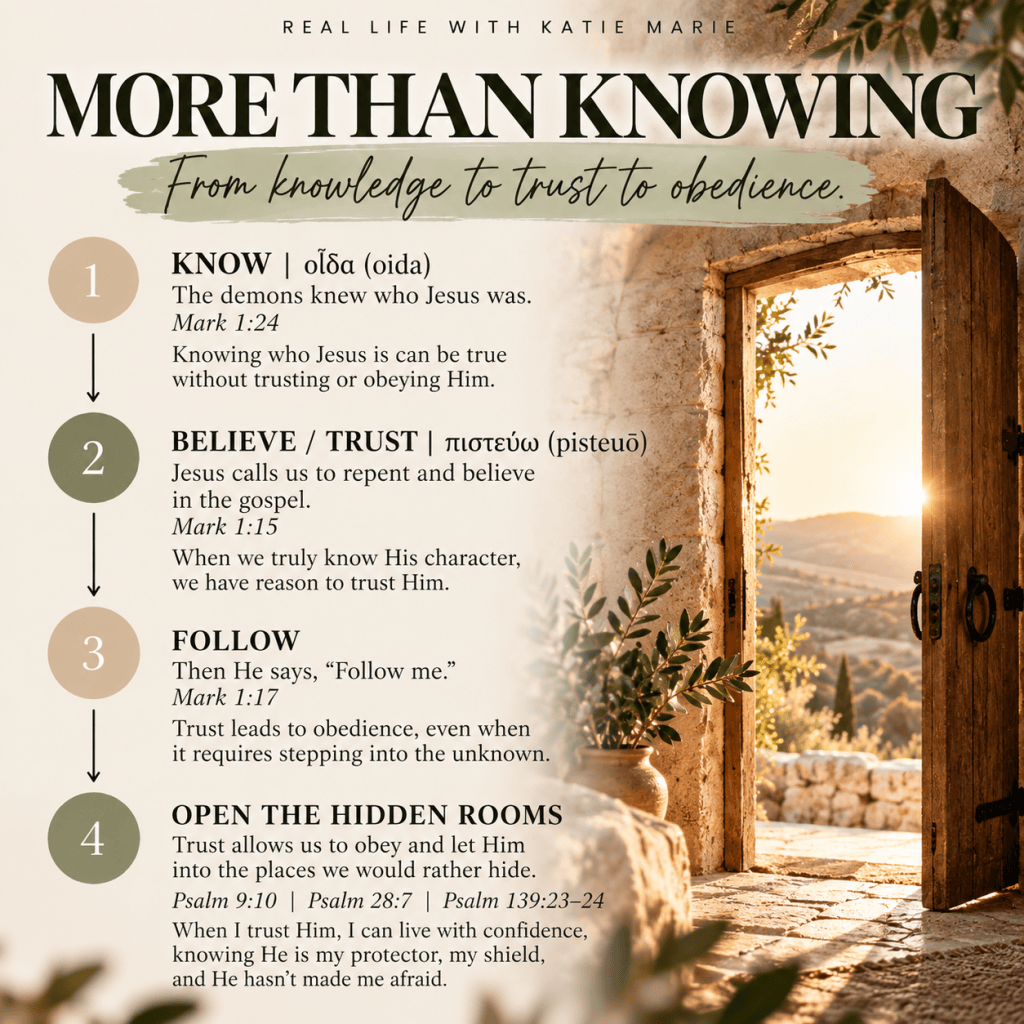
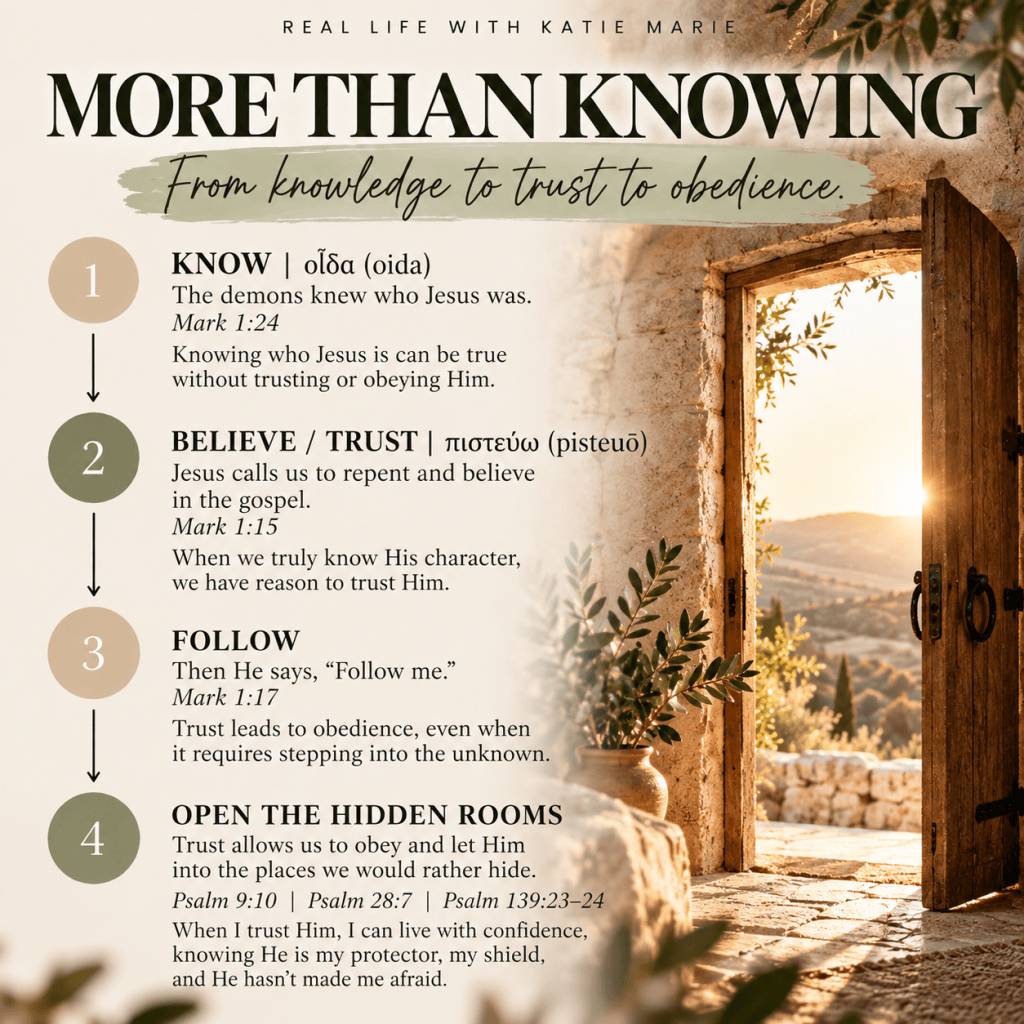
In Mark 1:24, an unclean spirit says:
“I know who you are—the Holy One of God.”
The Greek word translated “know” there is οἶδα (oida).
The demon knew something true about Jesus. It recognized Him. It knew who was standing in front of it.
But then I started looking at another way knowing Jesus is described in Scripture.
In John 10:14, Jesus says:
“I know my own and my own know me.”
The Greek word there comes from γινώσκω (ginōskō).
And look at the relationship Jesus is describing.
He knows His sheep.
His sheep know Him.
And in the next verse, Jesus compares that knowing to the Father knowing Him and Him knowing the Father.
It’s relational.
It’s reciprocal.
That is the contrast that caught my attention.
The demon could say:
“I know who You are.”
But Jesus says of His sheep:
“I know them, and they know Me.”
One passage shows recognition of His identity.
The other describes relationship.
I don’t want to turn two Greek words into a formula Scripture doesn’t give us. Oida doesn’t always mean mere “head knowledge,” and ginōskō isn’t exclusively used for relational knowledge.
But the contrast in these passages is powerful.
There is a difference between knowing who Jesus is and KNOWING Jesus.
Because I can know ABOUT Jesus without allowing what I know about Him to change my life.
I can know Scripture without trusting its Author.
I can know what Jesus said without actually following Him.
I can serve Him publicly without trusting Him privately.
I can spend my time doing things “for God” while keeping God at a distance from the places in me I don’t want anyone to see.
I can know that He is Lord without actually making Him Lord of my life—without surrendering my will, my plans, my desires, my fears, and the places where I still want control.
I can recognize His authority without submitting to it.
I can know who He is without trusting Him enough to follow where He leads.
That is the difference I don’t want to miss.
I don’t want to simply recognize who Jesus is.
I want to KNOW Him.
And I want knowing Him to change how I live.
Those Who Know Your Name Trust You
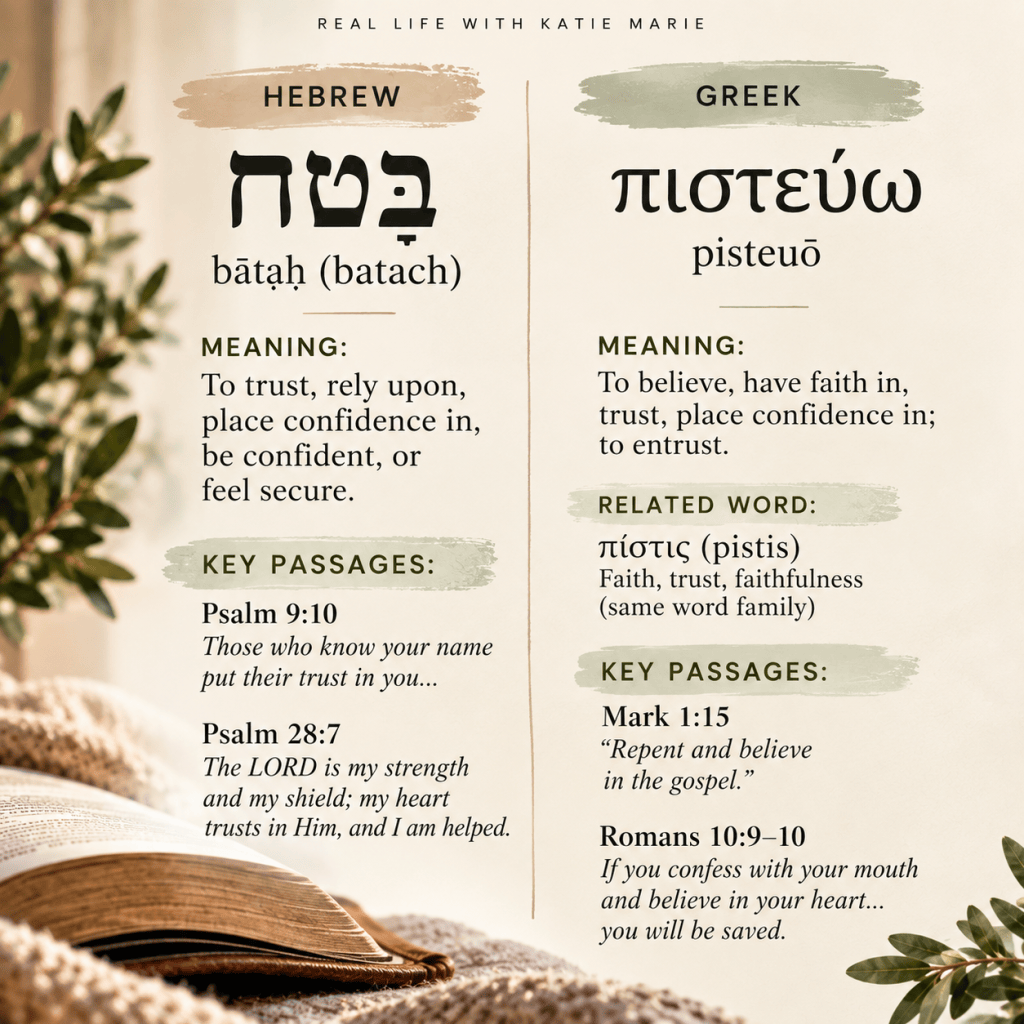
And that brings me to Psalm 9:10:
“Those who know your name trust in you.”
Those who KNOW Your name TRUST You.
There is a connection there that I don’t want to rush past.
The Hebrew word translated “know” comes from יָדַע (yada)—to know.
And the word translated “trust” comes from בָּטַח (batach)—to trust, rely upon, or place confidence in.
Knowing.
Trusting.
The more I know God—His character, His faithfulness, who He has shown Himself to be—the more reason I have to trust Him.
And trust isn’t something God has just started teaching me.
He has been developing it in me my entire life.
Trust Me with this.
Now trust Me here.
Trust Me again.
A little further.
A little deeper.
And what I’ve noticed is that the more I trust Him, the more He asks me to trust Him.
The greater the risk.
The greater the ask.
The greater the amount of trust required to take the next step.
Not because He hasn’t been trustworthy before, but because each new step takes me somewhere I haven’t been yet.
And every time, He is developing that trust muscle a little more.
Each step of faith stretches me.
Each step is uncomfortable.
Rarely do I walk through a door knowing what is waiting for me on the other side.
But I step anyway, because I know the One asking me to walk through it.
That doesn’t mean I don’t feel fear.
It doesn’t mean I understand what He’s asking me to do or where it will lead.
But I know something now that I didn’t know at the beginning:
I can do this because I’ve done it before.
I’ve trusted Him before.
I’ve faced fear and walked through the door anyway.
I’ve moved without knowing where He was taking me.
I’ve obeyed without knowing how it would turn out.
And every time I do, there is more history between us.
More evidence of His character.
More evidence of His faithfulness.
More reason to trust Him the next time He says, “Come.”
My trust isn’t blind.
It has history.
The more I truly know Christ—not just what I’ve been taught about Him, but who He has shown Himself to be—the more I can trust Him.
And the more I trust Him, the more willing I become to follow Him into places that require even greater trust.
Faith Has to Move
In Greek, πιστεύω (pisteuō) means to believe, have faith in, trust, or place confidence in. It belongs to the same word family as πίστις (pistis), faith.
Faith.
Belief.
Trust.
These ideas are deeply connected in Scripture.
At one point, faith for me was much closer to something I could say I had.
I believed in God.
I believed Jesus was who Scripture said He was.
But faith has become more than lip service.
Faith is active.
It requires obedience.
It requires trust.
That is one of the reasons Luke 5:5 has become so significant to me.
Peter has been fishing all night. He knows what he is doing. He knows the lake. He knows the nets. Everything he can see tells him that dropping those nets again doesn’t make sense.
And yet:
“Because you say so, I will let down the nets.”
Because You say so, I will.
There are seasons when that is what trust looks like.
Not:
Because I understand, I will.
Not:
Because I know how this ends, I will.
Not:
Because I’m comfortable, I will.
Because You say so, I will.
That kind of obedience requires more than information about Jesus.
It requires confidence in Him.
Trust Doesn’t Mean I’m Never Afraid
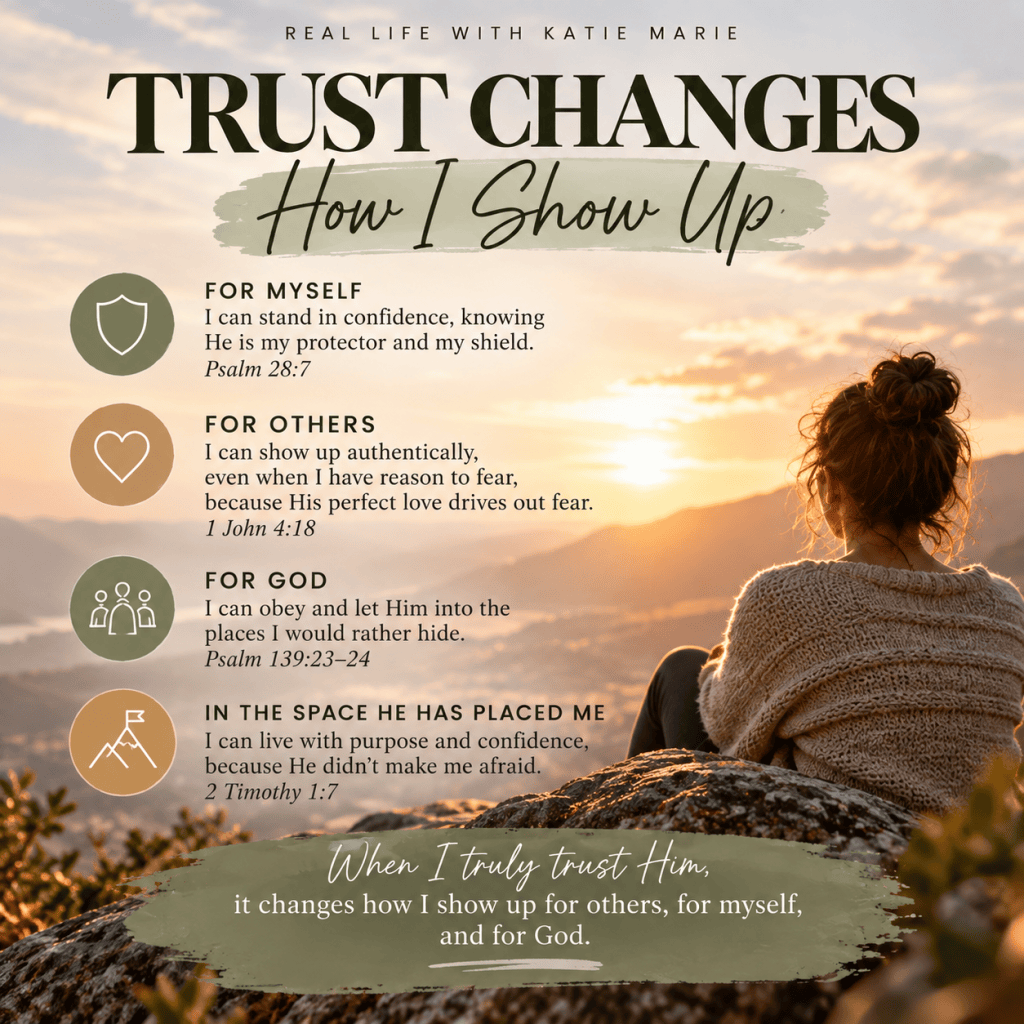
When I put my full confidence in Christ—when I remember that He has me covered, that He is my protector and my shield—I can stand differently.
Psalm 28:7 says:
“The LORD is my strength and my shield; my heart trusts in him.”
My confidence doesn’t have to come from believing nothing bad can happen.
My confidence comes from knowing Who is with me when it does.
That distinction matters because trust does not mean fear never shows up.
Psalm 56:3 says:
“When I am afraid, I put my trust in you.”
WHEN I am afraid.
Scripture doesn’t require me to pretend the fear isn’t there before I can trust God.
I can be afraid and still trust Him.
I can have legitimate reasons to be afraid and still refuse to allow fear to determine what I do next.
I can show up authentically.
I can obey without knowing what comes next.
I can stand confidently in the space God has given me.
I can stop allowing fear to determine how much space I am willing to occupy.
His perfect love drives out fear.
Fear is not what He has given me.
And when I truly sit in that place of trust, it changes how I show up.
It changes how I show up for others.
It changes how I show up for myself.
It changes how I show up for God.
I Also Want Him to Know Me
There is another side of this that I cannot ignore.
I don’t just want to KNOW Jesus.
I want Him to KNOW me.
And this brings me back to that relational knowing Jesus described in John 10:
“I know my own and my own know me.”
Jesus knows His sheep.
And His sheep know Him.
Then there are the words of Jesus in Matthew 7:21–23.
He describes people who call Him “Lord.” They point to things they have done in His name—even seemingly powerful spiritual works.
And yet Jesus tells them:
“I never knew you.”
The word translated “knew” there comes from that same Greek word, γινώσκω (ginōskō), that we saw in John 10.
There is a heaviness to those words that I can’t shake.
Because these aren’t people pointing to a complete absence of religious activity.
They are pointing to what they DID.
Look what I did in Your name.
Look how I served.
Look at the works.
And Jesus brings it back to relationship:
“I never knew you.”
Those words don’t only shape what I pray for myself.
They shape what I pray for the people I love.
I don’t just want my loved ones to know ABOUT Jesus.
I don’t just want them to grow up around church, know the Bible stories, know what Christians believe, or even know how to do all the things associated with following Jesus.
I want them to KNOW Him.
And I want Jesus to KNOW them.
That prayer carries a different kind of weight.
Because there are things I can teach the people I love about Jesus.
There are ways I can point them toward Him.
There are ways I can model what trusting Him looks like.
But I cannot have a relationship with Jesus for them.
I cannot surrender for them.
I cannot trust Him for them.
I cannot know Him for them.
So I pray that they will know Him for themselves.
That they will develop their own relationship with Him.
That they will learn His character and experience His faithfulness.
That they will trust Him for themselves.
That they will open every room of their hearts and lives to Him.
And I pray that when everything else is stripped away—church attendance, Bible knowledge, service, ministry, all the things we can point to and say we DID—that what remains is relationship.
That they know Jesus.
And that Jesus knows them.
That is what I want for myself too.
I don’t want to spend my life doing things “for God” while never allowing God into the deepest parts of me.
I don’t want to serve Him publicly while hiding from Him privately.
I don’t want to give Him my Sunday while keeping the rest of my life divided into rooms where He is welcome and rooms where He isn’t.
I want to KNOW Him.
And I want Him to KNOW me.
My greatest prayer is not only that I would know Him more fully, but that I would live fully known by Him—that I would invite Him into every room of my heart and every room of my life.
The beautiful rooms.
The broken rooms.
The rooms I’ve cleaned up enough for other people to see.
And the rooms I would rather lock the door to and pretend aren’t there.
The fear.
The pain.
The questions.
The anger.
The dreams.
The disappointment.
The things I’m proud of.
The things I’m ashamed of.
The places that still need healing.
I want Him there.
Not because He doesn’t already see them.
He does.
But there is a difference between being seen and willingly opening the door.
There is a difference between God knowing everything about me because He is God and me choosing to live fully known before Him.
Relationship requires that I stop hiding.
That I open the door.
That I invite Him into the places I would rather keep closed.
That I trust Him enough to let Him into all of me—not just the version of me I’m comfortable presenting.
I want to be fully known by God and still draw closer.
I want intimacy with Jesus, not simply proximity to Christianity.
Knowing Him Should Change Something
That brings me back to the demon in Mark 1.
It “knew” Jesus.
It knew who He was.
But that’s not the kind of knowing I want.
I don’t want to simply collect information about Jesus.
I don’t want to know all the right Bible stories, memorize the right verses, learn the right Greek and Hebrew words, go to church, serve every week, and stay busy doing things “for God” while still keeping Him at a distance from the places where I actually live.
I don’t want to mistake serving Him for knowing Him.
I want to KNOW Him.
And I want Him to KNOW me.
I want what I know about Him to affect what I do when life falls apart.
Where I turn when I am afraid.
Whose voice I trust when I don’t know what comes next.
How I obey.
How I love.
How I show up.
Because knowing Jesus should change something.
The more I know Him, the more I learn His character.
The more I know His character, the more reason I have to trust Him.
And the more I trust Him, the more freely I can obey Him.
Sometimes that obedience will make perfect sense.
Sometimes it will simply be:
Because You say so, I will.
I may not know what He is doing, but I know who He is.
And the more I know Him, the more I know I can trust Him.
The more I trust Him, the more freely I can obey Him—and the more confidently I can show up wherever He has placed me.
But underneath all of it is an even deeper prayer:
Jesus, I don’t just want to know about You.
I want to KNOW You.
And I want You to KNOW me.
And I want that for the people I love.
I pray that they would KNOW You.
That they would trust You.
That they would open every room to You.
And that they would be known by You.
And for myself, I want to open every room too.
Every wound.
Every fear.
Every dream.
Every part of my heart and every part of my life.
No locked doors.
No carefully curated version of me.
I want to know You deeply enough to trust You with all of me.
Real life • Real faith • God in the middle of it all.
– Katie Marie






Leave a comment